> ## Documentation Index
> Fetch the complete documentation index at: https://docs.fixaeo.com/llms.txt
> Use this file to discover all available pages before exploring further.
# Sources
> Which websites AI engines read and show when answering about you.
Sources shows what the AI engines actually pulled while answering your prompts.
The Sources page is a per-brand list of every website an engine touched while answering your tracked prompts. It splits that into two levels: pages the engine **showed** a reader, and pages it **fetched in the background** and never displayed. Both are useful, and they tell you different things.
## Citations and network sources
Four tiles sit above the table.
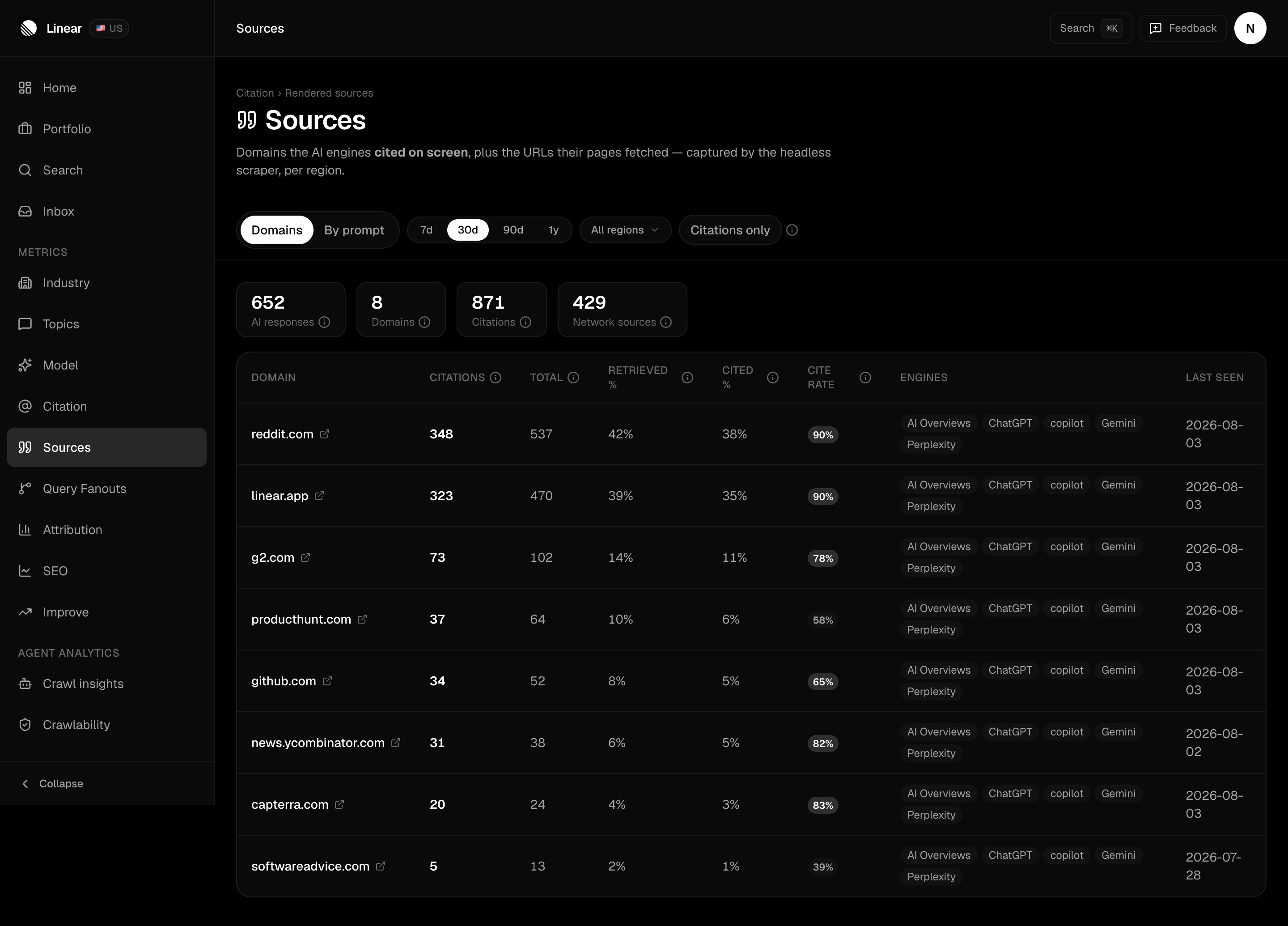
**AI responses** counts the answers captured in the window, across every engine and prompt. The percentage columns in the table are all measured against it.
**Domains** counts unique hostnames in the window. youtube.com is one domain no matter how many URLs came from it.
**Citations** counts the times an engine put a source on screen — a chip, a footnote, or a sources-panel row. This is the level a reader sees. [Citations](/citations) is the dedicated view for it.
**Network sources** counts the URLs an engine quietly fetched while drafting and then never showed the reader.
That gap is the interesting part. It's the difference between what an engine considered and what it was willing to put its name behind.
 This is observed data, not an estimate — it's what the engines actually loaded while answering. It only exists once a scan has run, so the page stays empty until then. Free plans don't get scheduled scans — see [Plans and limits](/plans-and-limits).
## The two views
This is observed data, not an estimate — it's what the engines actually loaded while answering. It only exists once a scan has run, so the page stays empty until then. Free plans don't get scheduled scans — see [Plans and limits](/plans-and-limits).
## The two views
 **Domains** rolls everything up by hostname. Each row gives you the domain (linking to a real example URL), Citations, Total, Retrieved %, Cited %, Cite rate, which engines used it, and when it was last seen.
* **Total** covers both levels, shown and fetched, so it's always the larger number.
* **Retrieved %** is how often the domain turned up at all.
* **Cited %** is how often it was shown on screen.
* **Cite rate** is the one to read first: when an engine pulls this domain, how often does it actually show it?
The **Citations only** toggle hides hosts that were never shown on screen. Rows that stay still report their full totals.
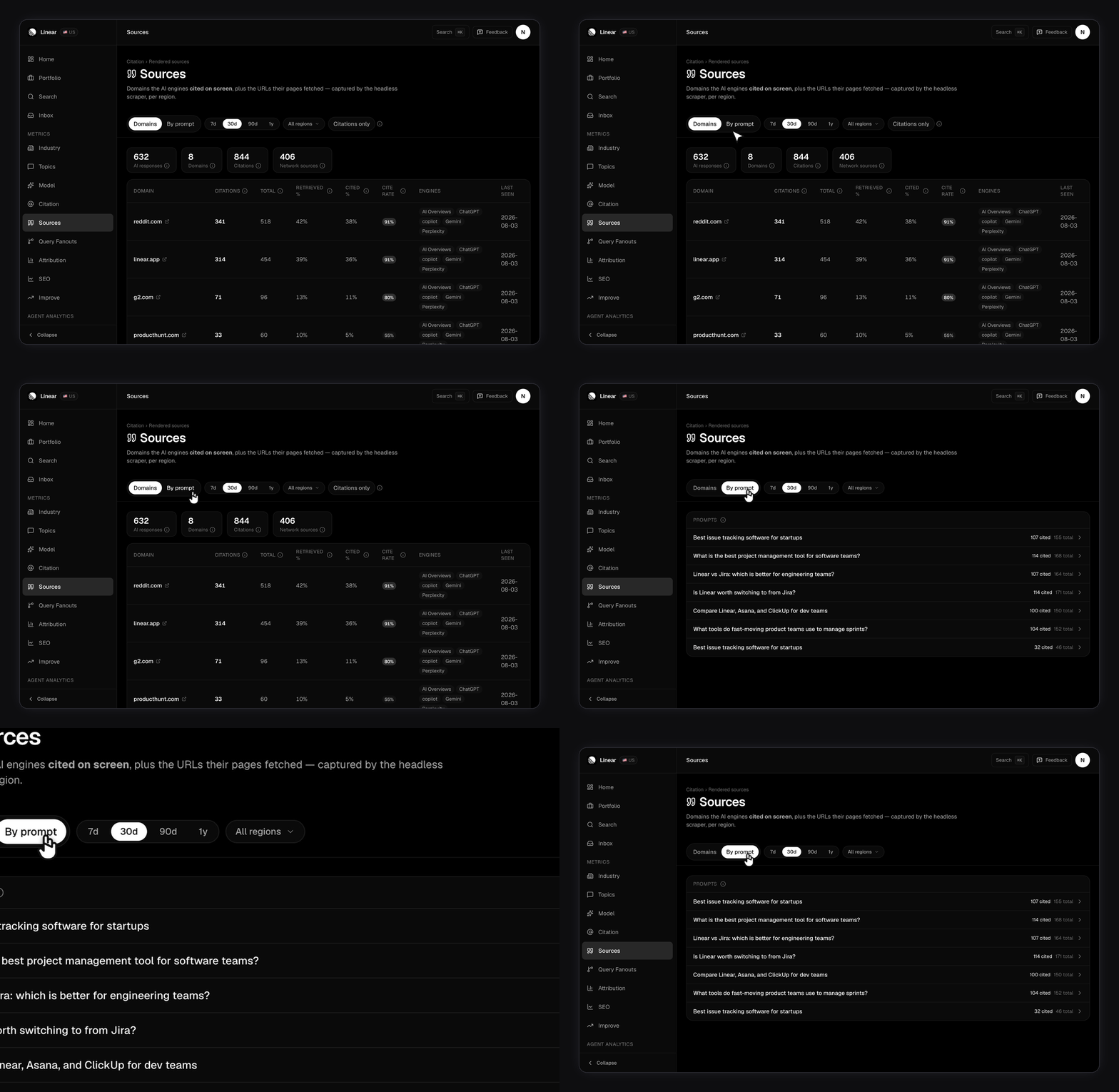
**By prompt** flips the axis. Each prompt shows a cited count and a total, and expands into the URLs behind them, tagged `cited` or `network`. This is where you find out that one prompt is quietly feeding an engine a competitor's comparison page.
Filter both views by date range and region.
## How do you read the cite rate?
Compare a domain's Citations column against its Total column, or just read the Cite rate column. Three patterns are worth acting on.
**High total, low citations.** The engines keep fetching this site and keep deciding not to show it. It's in the retrieval pool but not trusted enough to display. A placement there is worth less than the raw numbers suggest.
**High total, high citations.** The engines both read it and quote it. This is the strongest placement target in your category.
**Your own domain, low on both.** The engines aren't reaching your pages at all. That's a content and structure problem before it's a placement problem. [Improve](/improve) turns this into specific work.
## Finding placement and partnership opportunities
Sources is the most direct path from a number to a task. A working method:
Start with what readers actually see. Everything else is context.
Sort by citations. The top domains that don't mention you are shaping your category's answers without you in them.
A high-citation domain in the Earned Media bucket is a pitch. One in Social is a thread to join. One in Institution is a listing to get into. See [Citations](/citations).
Read the exact page the engine cited. Often it's a roundup you can ask to join, or a comparison with your details out of date.
Check which prompt pulls that domain. That tells you which customer question the placement will influence.
A single correction on a page the engines already cite often beats a new page of your own. They've already decided to trust that domain. Getting into it is cheaper than earning that trust yourself.
## How this relates to your other pages
Sources is per-brand and shows both levels, fetched and shown. [Citations](/citations) covers only what was shown, but adds category, share, rank, sentiment, and export. [Industry benchmarks](/industry) tells you which competitors those sources are naming instead of you.
If a domain here surprises you, go read the answer it came from. [Understanding AI answers](/understanding-answers) shows you how.
**Domains** rolls everything up by hostname. Each row gives you the domain (linking to a real example URL), Citations, Total, Retrieved %, Cited %, Cite rate, which engines used it, and when it was last seen.
* **Total** covers both levels, shown and fetched, so it's always the larger number.
* **Retrieved %** is how often the domain turned up at all.
* **Cited %** is how often it was shown on screen.
* **Cite rate** is the one to read first: when an engine pulls this domain, how often does it actually show it?
The **Citations only** toggle hides hosts that were never shown on screen. Rows that stay still report their full totals.
**By prompt** flips the axis. Each prompt shows a cited count and a total, and expands into the URLs behind them, tagged `cited` or `network`. This is where you find out that one prompt is quietly feeding an engine a competitor's comparison page.
Filter both views by date range and region.
## How do you read the cite rate?
Compare a domain's Citations column against its Total column, or just read the Cite rate column. Three patterns are worth acting on.
**High total, low citations.** The engines keep fetching this site and keep deciding not to show it. It's in the retrieval pool but not trusted enough to display. A placement there is worth less than the raw numbers suggest.
**High total, high citations.** The engines both read it and quote it. This is the strongest placement target in your category.
**Your own domain, low on both.** The engines aren't reaching your pages at all. That's a content and structure problem before it's a placement problem. [Improve](/improve) turns this into specific work.
## Finding placement and partnership opportunities
Sources is the most direct path from a number to a task. A working method:
Start with what readers actually see. Everything else is context.
Sort by citations. The top domains that don't mention you are shaping your category's answers without you in them.
A high-citation domain in the Earned Media bucket is a pitch. One in Social is a thread to join. One in Institution is a listing to get into. See [Citations](/citations).
Read the exact page the engine cited. Often it's a roundup you can ask to join, or a comparison with your details out of date.
Check which prompt pulls that domain. That tells you which customer question the placement will influence.
A single correction on a page the engines already cite often beats a new page of your own. They've already decided to trust that domain. Getting into it is cheaper than earning that trust yourself.
## How this relates to your other pages
Sources is per-brand and shows both levels, fetched and shown. [Citations](/citations) covers only what was shown, but adds category, share, rank, sentiment, and export. [Industry benchmarks](/industry) tells you which competitors those sources are naming instead of you.
If a domain here surprises you, go read the answer it came from. [Understanding AI answers](/understanding-answers) shows you how.